TOPICS

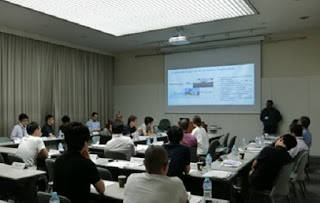
Report on the 10th IIR Summer School

Institute of Innovation Research has been holding the IIR Summer School every year since 2010. The memorable 10th Summer School was held at Sano-Shoin Hall, Hitotsubashi University on August 22, 2019.

The purpose of this summer school is to promote innovation research by building researcher networks, offering a place for presenting the latest research results, and supporting young researchers. This year, we invited five research presenters from abroad and a total of 10 presentations were made (2 were in Japanese and 8 in English).

The Best Presentation Award was awarded to Yuki Higuchi, Associate Professor of Nagoya City University.
The title of his presentation was “Management and Innovation: Evidence from Randomized Experiments and Repeated Surveys in Vietnam”

The participants were wide ranging from graduate students to researchers and business practitioners. We thank them all for their participation.

The program of the 10th IIR Summer School can be accessed from below.
https://www.iir.hit-u.ac.jp/blog/2019/07/26/summer-school-2/

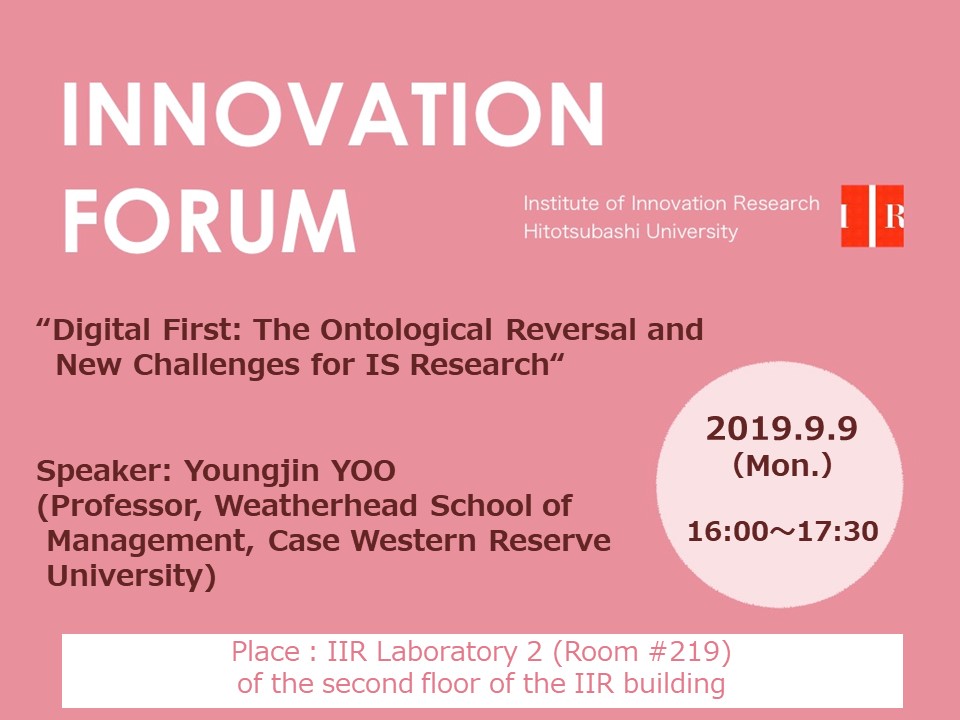
Forum 2019.9.9 Youngjin YOO

Innovation Forum 2019.9.9 Youngjin YOO

Topic:

Digital First: The Ontological Reversal and New Challenges for IS Research
Speaker:

Youngjin YOO

(Professor, Weatherhead School of Management, Case Western Reserve University)
Date:
September 9th (Monday)  2019
from 16:00 to 17:30
Place:
 IIR Laboratory 2 (Room#219) of the second floor of the IIR building
Organizer:
 Yaichi Aoshima 

Abstract:
The classical view of an information system is that it represents and reflects physical reality. 
We suggest this classical view is increasingly obsolete: digital technologies 
are now creating and shaping physical reality. 
We call this phenomenon the ontological reversal. 
The ontological reversal is where the digital version is created first, and the 
physical version second (if needed). 
This ontological reversal challenges us to think about the role of humans and technology in society.
It also challenges us to think about our role as IS scholars in this digital world
and what it means for our research agendas.

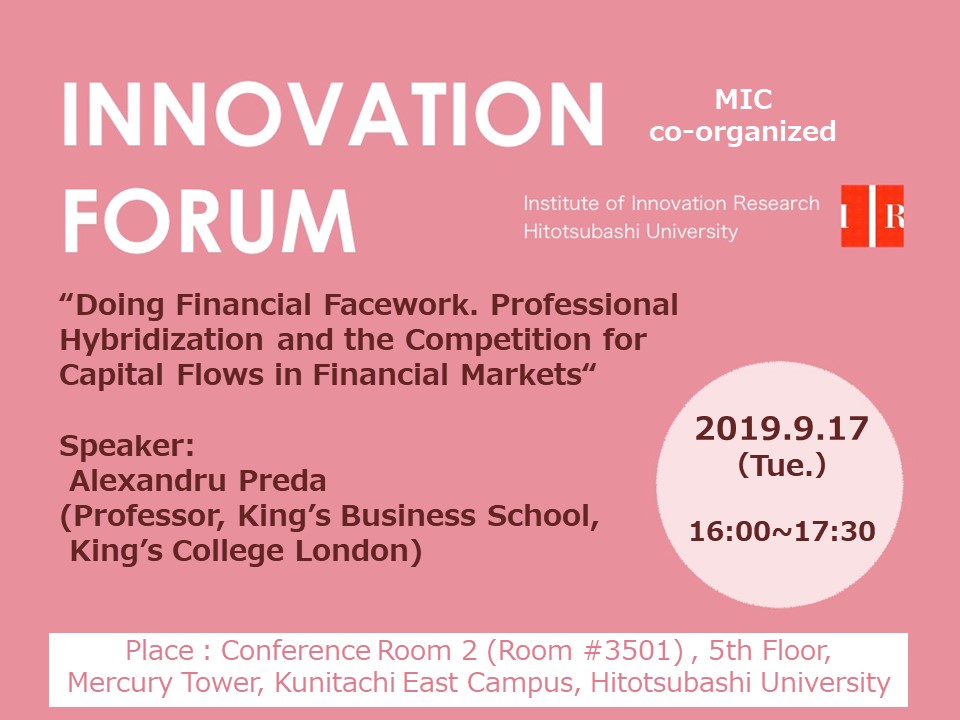
Forum 2019.9.17 Alexandru Preda

Innovation Forum 2019.9.17 Alexandru Preda

Topic:

“Doing Financial Facework. Professional Hybridization and the Competition for
 Capital Flows in Financial Markets
Speaker:

Alexandru Preda

(Professor, King’s Business School, King’s College London)
Date:
September 17th (Tuesday)  2019
from 16:00 to 17:30
Place:
 Conference Room 2 (Room#3501), 5th Floor, Mercury Tower,
 Kunitachi East Campus, Hitotsubashi University
Organizer:
 Takahiro Endo 

 This forum is jointly organized by MIC (Management Innovation Research Center), 
 Hitotsubashi University.

Report on the 14th Hitotsubashi Business Review Forum

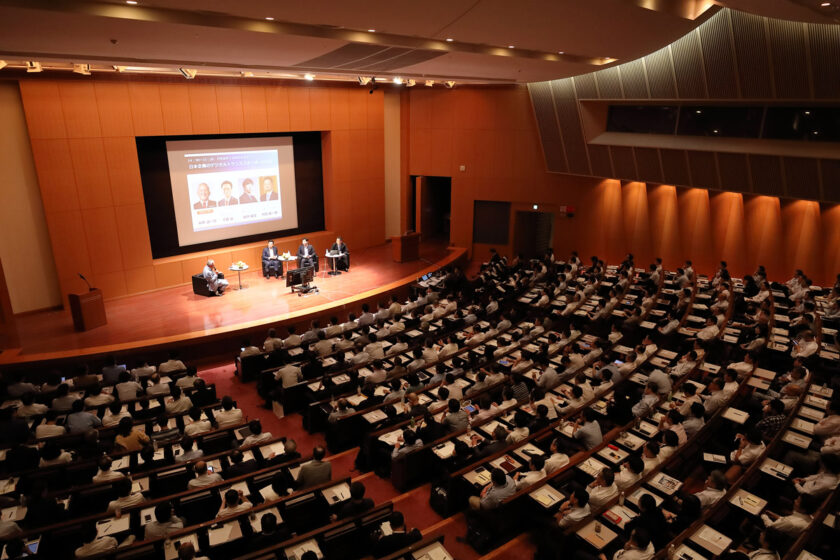
The 14th Hitotsubashi Business Review Forum “Preparing for the Future – Challenges and Chances for Japanese Businesses in the Digital Age” was held at Hitotsubashi Hall on July 18, 2019. Lectures were given in front of an audience of nearly 400 participants and the forum was closed in great success.

Guest speakers included President, Satoshi Hirano (Topcon Corporation), Chairman, Kentaro Ohyama (Iris Ohyama Inc.), President Makoto Kouyama (Alibaba.com Japan Co., Ltd.) who respectively participated in one-on-one dialogues: Mr. Hirano with Professor Emeritus Seiichiro Yonekura; Mr. Oyama with Professor Emeritus Ikujiro Nonaka; and Mr. Kouyama with Professor Ken Kusunoki.

In addition, Mr. Yasufumi Fujii, East Asia Sales Manager of beBit, Inc. and Mr. Soichiro Murata, Director, Internet of Things / Fourth Industrial Revolution, Industry Value Engineering, SAP Japan Co., Ltd. were invited for a panel discussion along with Mr. Satoshi Hirano.

We extend our appreciation to all the participants.

The program of the 14th Hitotsubashi Business Review Forum can be accessed from below.
https://www.iir.hit-u.ac.jp/blog/2019/06/10/info-brforum014/  (In Japanese)

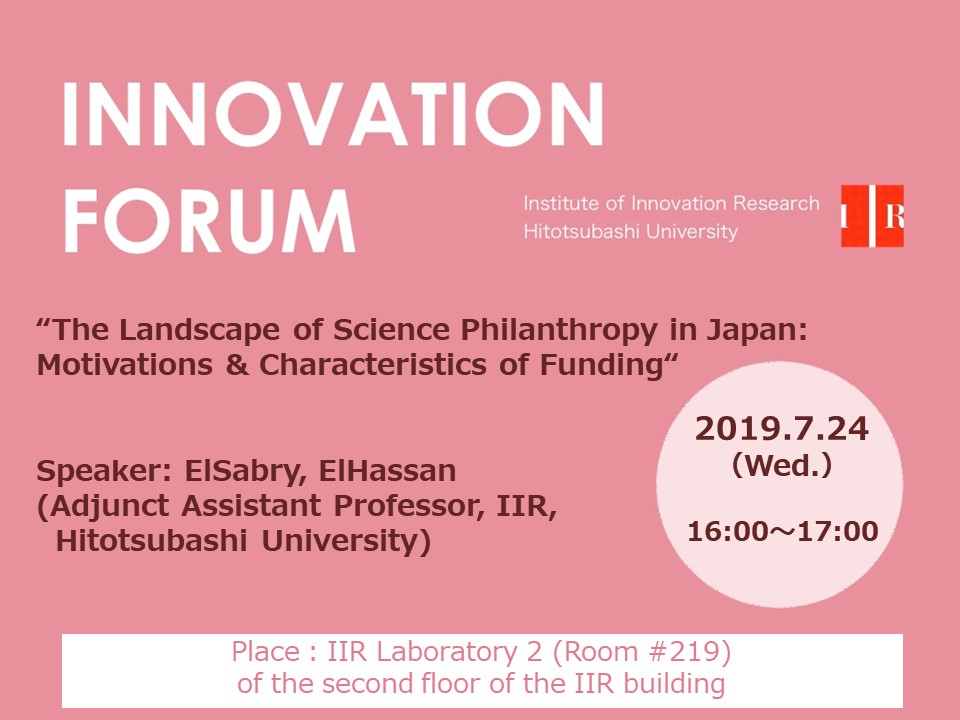
Forum 2019.7.24 ElSabry, ElHassan

Innovation Forum 2019.7.24 ElSabry, ElHassan

Topic:

“The Landscape of Science Philanthropy in Japan: Motivations & Characteristics of
  Funding
Speaker:

ElSabry, ElHassan

(Adjunct Assistant Professor, IIR, Hitotsubashi University)
Date:
July 24th (Wednesday)  2019
from 16:00 to 17:00
Place:
 IIR Laboratory 2 (Room#219) of the second floor of the IIR building
Organizer:
 Masaru Karube 

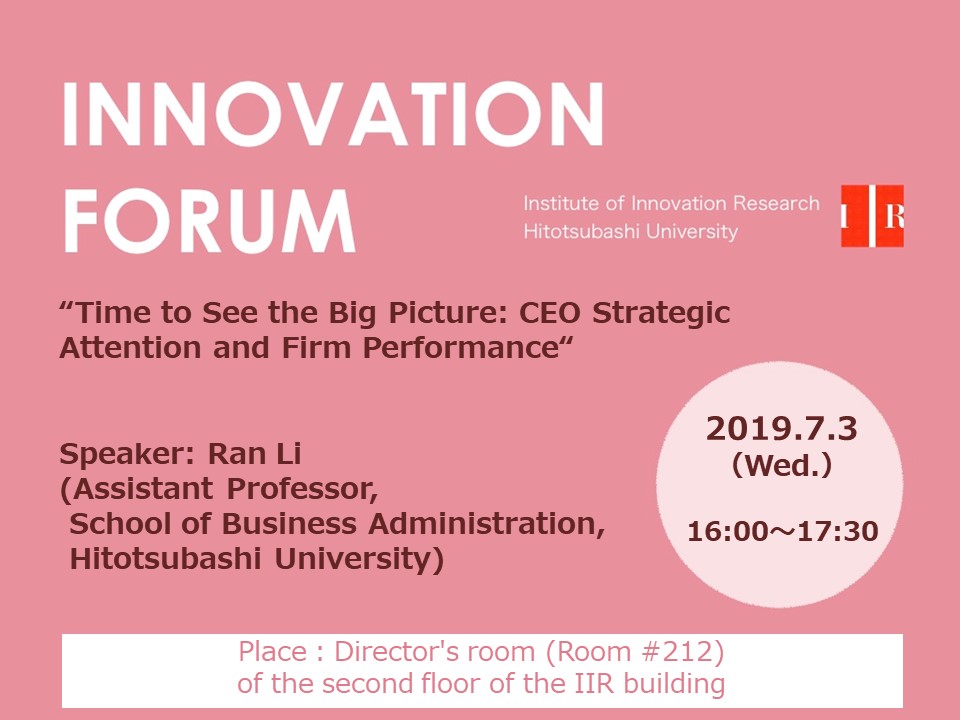
Forum 2019.7.3 Ran Li

Innovation Forum 2019.7.3 Ran Li

Topic:

“Time to See the Big Picture: CEO Strategic Attention and Firm Performance
Speaker:

Ran Li

(Assistant Professor, School of Business Administration, Hitotsubashi University)
Date:
July 3rd (Wednesday)  2019
from 16:00 to 17:30
Place:
 Director’s room (Room#212) of the second floor of the IIR building 
Organizer:
 Masaru Karube 

Brown bag lunch seminar 2019.7.1 Yongrae Cho

Brown bag lunch seminar 2019.7.1 Yongrae Cho

Topic:

How Can New Bibliographic Methodology with Standard and Patent Contribute to
  Detect Industrial Changes?
Speaker:

Yongrae Cho

(Research Fellow, Science and Technology Policy Institute)
Date:
July 1st (Monday)  2019
from 12:40 to 13:30
Place:
 IIR Meeting Space (Room#216) of the second floor of the IIR building 
Organizer:
 Byeongwoo Kang

Deadline:
 9:00, July 1 , 2019


IIR Brown bag lunch seminar 


Forum 2019.7.4 Ishtiaq Pasha Mahmood

Innovation Forum 2019.7.4 Ishtiaq Pasha Mahmood

Topic:

“Corruption, Local Knowledge, and Firm Productivity: Evidence from an Emerging Economy
Speaker:

Ishtiaq Pasha Mahmood

(Professor, National University of Singapore)
Date:
July 4th (Thursday)  2019
from 16:00 to 17:30
Place:
 IIR Laboratory 2 (Room#219) of the second floor of the IIR building 
Organizer:
 Masaru Karube 

Abstract:

An understanding of how corruption affects firm productivity is critical for identifying the microeconomic linkages by which macro institutions shape economic development.
Despite a growing consensus that corruption impedes growth, the coincidence of exceptional growth records and thriving corruption cultures in many emerging economies remains a puzzle. Our goal is to theoretically analyse the effect of corruption on firm productivity and empirically test it with a cleaner identification strategy. Using a sample of Indonesian manufacturing firms and exploiting a combination of the fall of Suharto and the establishment of the anti-corruption body KPK as an exogenous shock to corruption costs, we find strong evidence to support our theory. While corruption hurts productivity, access to local knowledge helps absorb the negative impacts of corruption; intriguingly, both effects depend on the nature of political regime.

Business Review Vol.67 No.1 SUM. 2019

Vol.67 No.1 SUM. 2019 (In Japanese)

A leading management journal in Japanese,
which builds a bridge between theory and practice.

EDITED BY
Hitotsubashi University, Institute of Innovation Research
PUBLISHED BY
Toyo Keizai Inc.

A New Wave of “Education Reform”

Kan Suzuki
“What Is the 21st Century Education?: Discussion at OECD and New Practices from Japan“

Yuichi Kudo
“Creating a New School System: A Challenge of Kojimachi Public Junior High School

Kanji Miyaji
“’Quest Education’: An Education Reform Challenge from Business Perspective

Yusuke Mizuno
“New Education in Reiwa Era – Nurture and Maximize Each Teenager’s Potential:
Practice and Challenge of Nurturing Creativity by Life Is Tech !

Genki Jinno / Jun Sato
“What Adaptive Learning Brings to Public Education:
Demonstration of Evidence in Public Junior High School Utilizing Qubena


Sota Fukushima
“Projecting the Future of Education Reform through Active Learning:
Is That Initiative Authentic or Not?


●Brand Management by All Stakeholders (2)
  Satoko Suzuki

●International Standardization from JAPAN (7)
  Manabu Eto / Yuichi Washida

 
●Business Cases
  Akira Takeishi / Yaichi Aoshima
 “Shimano: Untiring Challenges of a Leading Bicycle Component Manufacture
 
 Jin-ichiro Yamada / Osaka City Univ. Yamada Seminar
 “GLM: The Electric Vehicles Ecosystem Emergence Process in Japan
 
 Manabu Eto
 “Mercari: Idea and Realization of ‘World-class Services’
 
 
●Management Forum
  Haruaki Deguchi
 (President, Ritsumeikan Asia Pacific University
)
  Interviewed by Seiichiro Yonekura
 

Report on the SSE and Hitotsubashi Joint Symposium on Innovation Ecosystem

The SSE and Hitotsubashi Joint Symposium on Innovation Ecosystem -A Key to Successful Innovation: Lessons from Swedish and Japanese Start-up Practices- was held at the National Center of Science Building (Gakujutsu Sogo Center), on May 16, 2019.

The symposium was jointly organized by The Institute of Innovation Research, Hitotsubashi University and The House of Innovation (HOI) and the European Institute of Japanese Studies, Stockholm School of Economics, in collaboration with Toyokeizai, Business Forum, HUB FinTech Forum and IMPP. Although held on a weekday, the symposium enjoyed the participation of more than 100 visitors and received positive reviews.

The program of the SSE and Hitotsubashi Joint Symposium can be accessed from below.
https://www.iir.hit-u.ac.jp/blog/2019/03/27/info-sse/
https://www.iir.hit-u.ac.jp/en/2019/04/02/sse-and-hitotsubashi-joint-symposium-on-innovation-ecosystem-2019-5-16/

In Session One “Emerging Fintech,” Mr. Michal Gromek (Head of Operations and Compliance, Safello AB) gave a presentation on The Development of the Swedish Fintech Ecosystem. He spoke about the current situation of Sweden where fintech is developing at high speed, but many problems remain to be solved such as the legal system which is not yet aligned with the rapid development of technologies.

Following Mr. Gromek, Mr. Daisuke Sasaki (CEO, freee K.K.) gave a presentation on the Trends in Japanese FinTech and freee’s innovation. He explained how he started his business based on the belief that boosting the productivity of SMEs will lead to the growth of the entire Japanese economy and how his company grew to be so large starting from the development of an accounting software. He also shared his personal feelings behind his success.

In light of the above two presentations, a panel discussion was held under the moderation of Emeritus Professor Seiichiro Yonekura (Institute of Innovation Research, Hitotsubashi University / Professor, Hosei University) and opinions were actively exchanged among Professor Mikiharu Noma (Hitotsubashi University Business school), Mr. Gromek and Mr. Sasaki, sparking an in-depth discussion on the theme. The discussion emphasized that not only efforts by technology experts and business managers, but the cooperation of legal experts is essential for the development of fintech.

It was also mentioned that Japanese government officials are also willing to contribute to the development of fintech, which highlighted the fact that close communication with policymakers was also very important.

In Session Two “Systems and Management of Innovation,” Mr. Yoshiaki Ishii (Director, Science, Technology and Innovation, Cabinet Office) first gave a presentation on Creating an Innovation Ecosystem in Japan. He explained the recent status of business startups in Japan and comprehensively introduced various measures implemented by the Japanese government and private sector to promote innovation in Japan.

Next, Ms. Zelia Sakhi (Chief Experience Officer of Virtusize Japan) gave a presentation titled, Customer-centric Innovation, the Swedish Way. She explained in detail and presented some specific examples of the process of how customer-centered innovation is created in Sweden.

In the following panel discussion moderated by Professor Mattia Bianchi (HOI, Stockholm School of Economics), Assistant Professor Mark A. Conley (Stockholm School of Economics), Mr. Ishii and Ms. Sakhi engaged in a multi-perspective discussion by sometimes comparing the systems and management styles of Japan and Sweden. They pointed out that the interaction between macro-processes such as policy development and micro-processes carried out by individual organizations and persons is the key to the sustainable creation of innovation.

With the closing remarks given by Mr. Martin Koos (General Manager of the Swedish Chamber of Commerce and Industry in Japan (SCCJ)), the symposium concluded in great success.

We extend our appreciation for your cooperation and to everyone who participated.